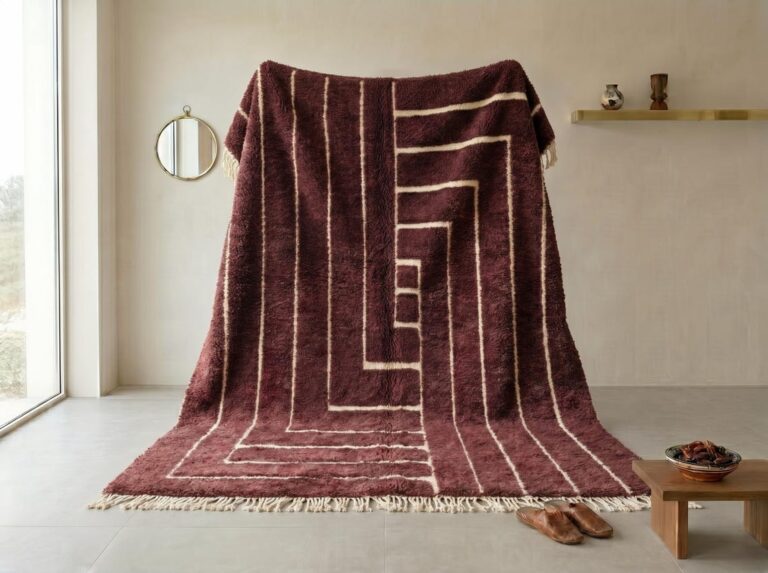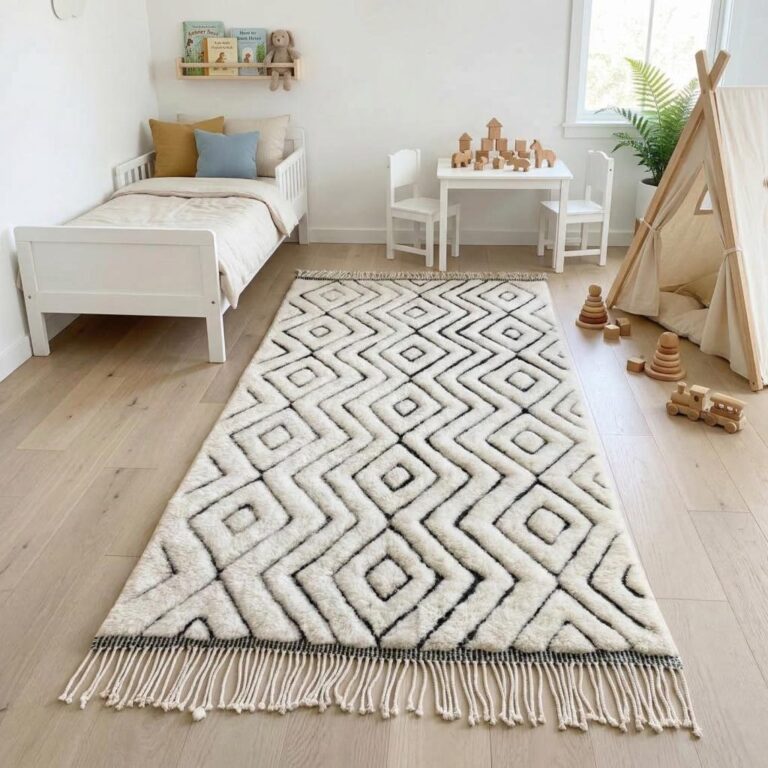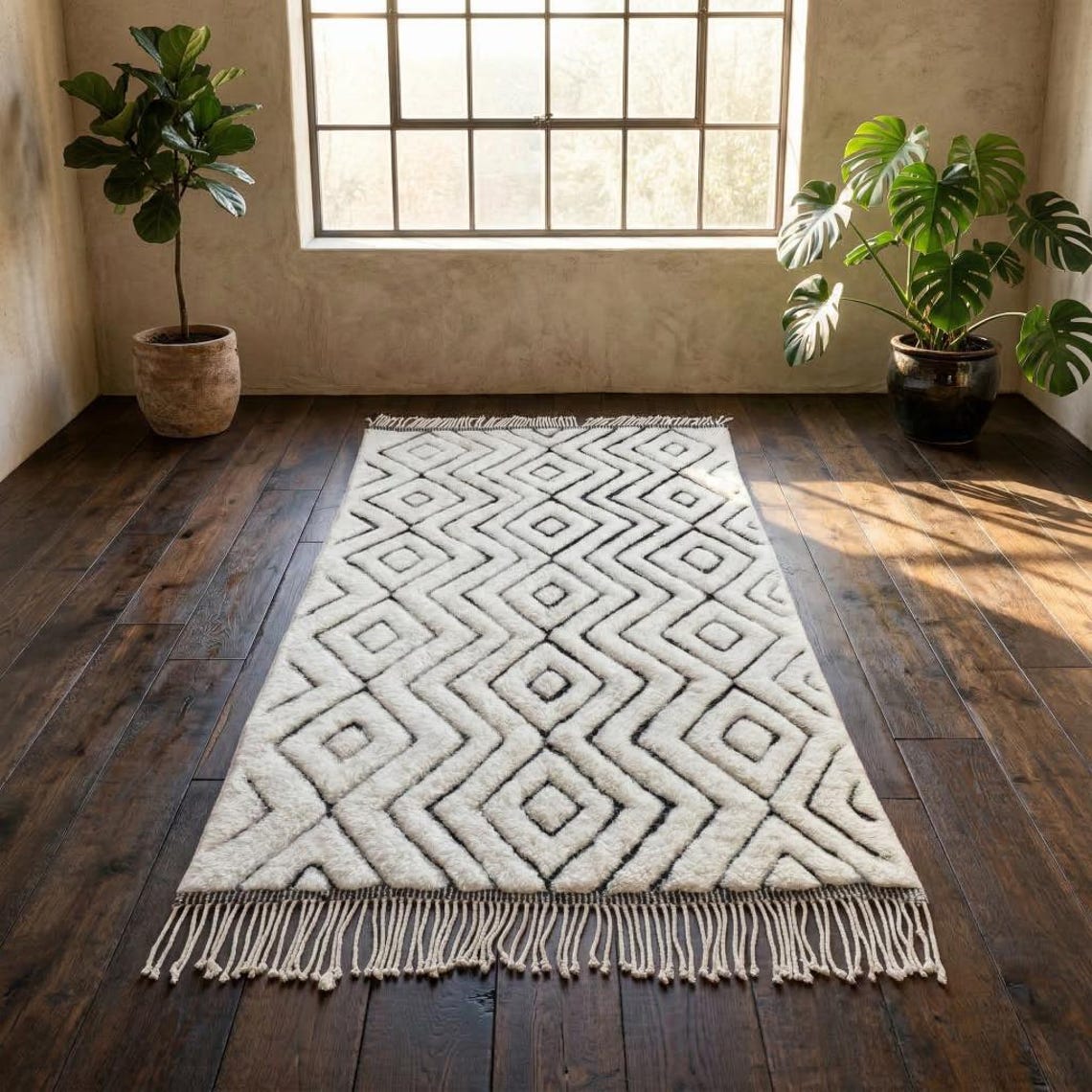
The popularity of Moroccan rugs has brought a flood of machine-made copies, often sold with words like “Moroccan style” or “Beni Ourain inspired”. They can look similar in photos, but they do not have the feel, durability or value of a real handmade Berber rug. Here are seven simple checks to help you buy with confidence.
1. Turn it over and look at the back
This is the most reliable test. On a hand-knotted rug, the back shows every individual knot, and the pattern on the back mirrors the pattern on the front, slightly less sharp. On a machine-made rug, the back looks very uniform and grid-like. On a tufted rug, the back is usually covered with a glued fabric or latex backing that hides the construction.
2. Check the fringe
On a hand-knotted rug, the fringe is the continuation of the warp threads that run through the whole rug on the loom. It is part of the rug, not an add-on. If the fringe is sewn or glued onto the ends, the rug was most likely made by machine.
3. Look for small irregularities
Berber weavers draw their patterns freely, often from memory. Lines are rarely perfectly straight, motifs are not perfectly symmetrical, and the edges may be slightly uneven. These irregularities are a sign of the human hand, not a defect. A rug that looks perfectly identical from one side to the other is a warning sign.
4. Feel the wool
Real Moroccan rugs are made from sheep’s wool, which feels springy, slightly oily from natural lanolin and warm to the touch. Synthetic fibres such as polyester or polypropylene feel slippery, shiny or plasticky. A light shedding in the first weeks is normal for hand-spun wool.
5. Ask about the materials and the maker
A genuine seller can tell you where the rug was made, by whom and with what wool. Be cautious of vague descriptions. At BeniWool, every rug is hand-knotted in our own atelier in Azrou, in the Middle Atlas, by Berber women artisans paid fair wages, and we send you progress photos from the loom while your rug is being made.
6. Consider the weight
A thick hand-knotted wool rug is heavy. A Beni Ourain of around 200 x 300 cm can weigh many kilos, because it contains a large quantity of dense wool. Very light rugs of the same size are usually thinner or made from cheaper materials.
7. Be realistic about the price
A large hand-knotted rug takes weeks of skilled work, plus the cost of good wool. If a large “Beni Ourain” costs about the same as a machine-made rug in a big-box store, it is almost certainly not hand-knotted in Morocco.
Hand-knotted vs hand-tufted: what is the difference?
Both can be made by hand, but the techniques are different. Hand-knotting ties each knot individually around the warp threads, the traditional Berber method, and produces the most durable rugs. Hand-tufting punches yarn through a backing fabric with a tool and then secures it with a glued backing, which is faster. If you want a traditional Moroccan rug that lasts for generations, look for hand-knotted.
Buy directly from the atelier
The easiest way to be sure is to buy from the people who make the rug. All BeniWool rugs are hand-knotted to order in Azrou in any size, shipped free by DDP express worldwide with duties included, and covered by a 30-day money-back guarantee. Explore our handmade Moroccan rugs or meet our artisans.
Every BeniWool rug is hand-knotted by Berber women artisans in Azrou, and we send progress photos while yours is made. Browse our authentic Beni Ourain rugs, Azilal rugs and Boujaad rugs, or design your own custom-size Moroccan rug.